3650 nappy changes: make the worst the best

I read somewhere that you can’t consider yourself a true mummy blogger until you’ve written about poop. So here goes!

By the time your baby is two years old you could have easily changed their nappy 3650 times. That’s a lot of nappies and let’s face it, poopy nappies aren’t one of the perks of being a parent. My suggestion this week, thinking about giving your baby a great start in life, is to re-frame how your view nappy change time. How about having 3650 occasions when you can gaze into your babies eyes and really connect with them? When you have some one-to-one language tuition or help them learn to count?

I think especially when you have more than one child in your family, or when you’re childminding or working in a setting with several other children, changing a baby’s nappy gives you a valuable time to focus solely on them. Here are some ideas you could incorporate into your changing times this week, helping them develop language, maths and more, simply as part of your daily routine.

  • Make eye contact and chat together. Give a running commentary on what you’re doing, ask your baby’s permission before you touch them and pause to give them the opportunity to respond. This helps your baby’s language development and teaches them that you respect them. One day soon they’ll start to answer you back.
  • Count their buttons and poppers as you undo and fasten them, and look forward to the day when they join in with you.
  • Sing a song. Your baby will love the sound of your voice (even if it’s as tuneless as mine!) and the rhythms of traditional nursery rhymes are well suited to learning your spoken language.
  • Pull funny faces as see if you can make them giggle. This encourages them to focus on your face and begin to understand how different expressions convey different meaning.

All of these are such simple ideas and so easy to incorporate in your routine but over those 3650 occasions they can make a real difference. I think adopting this more mindful approach to nappy time makes changing time much nicer for us too, as we are conscious that the care we give to our baby is part of how we educate them too. What are your tips for nappy time?
super baby play ideasOur SUPERbaby play series focuses on simple, playful ideas you can use with the youngest of children to have fun and encourage them to develop important early learning skills. The emphasis is on ideas you can easily fit into a busy week, using materials you’ll have around your home. View all our SUPERbaby ideas here.
Valentine’s mobile for babies

valentines mobile
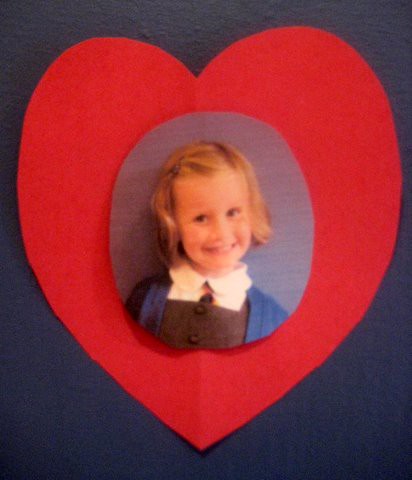
Include your baby in the Valentine’s Day celebrations with this easy to make Valentine’s mobile. (Even better if you have an older brother or sister around who can help with the cutting and sticking).

Babies love looking at faces, especially ones they recognise as being special to them. Mobiles are a great way to help your baby develop their focus and track objects, and they can help keep them entertained when you’re changing their nappy or when they’re having some tummy time.

Here’s how to make it:

Look at these step by step drawings for more details

1. Cut out some hearts from red card – around eight is a good number to fit the mobile.

2.Print some photos of the people your baby loves: parents, siblings, grandparents and even pets. Cut out the faces and stick one in the centre of each heart. You might like to put a face on each side so there’s someone to look at whichever way the mobile turns.

3. To make  the mobile, cut out a hoop from a piece of thick card, about the size of a large dinner plate and with a width of about 5cm.

4. Make four holes at even spaces around the hoop and thread through some string, wool or ribbon. Tie the four threads together and use this to hang your mobile.

5. Add threads to each of your hearts and fasten them to the hoop. An easy way to do this is with a sewing needle and some cotton.  Thread the cotton through the needle and knot one end. Push the needle through the heart, then push it through the hoop. Leave a long thread so the heart dangles down and tie a knot at the other end to hold it in place. Place your hearts at even spaces around the hoop to help your mobile balance and hang well.

6. To make a simpler version you can hang the hearts from a ‘washing line’. Fasten a length of ribbon or thread between two nails and tie or peg the hearts along the line.

7. Hang your mobile or washing line where your baby can see it and the faces on the hearts are visible, but just out of their reach so there is no chance of them getting tangled up. You might find it better placed slightly to the side over their nappy changing table, as babies most often lie with their head turned a little.

We have more Valentine’s crafts in our archive including a Valentine shaker, just right for musical babies.

**********************************************

Our SUPERbaby play series focuses on simple, playful ideas you can use with the youngest of children to have fun and encourage them to develop important early learning skills. The emphasis is on ideas you can easily fit into a busy week, using materials you’ll have around your home. View all our SUPERbaby ideas here.
happily shared with Works for Me Wednesday and Craft Schooling Sunday and the Virtual Valentine’s Day Party

Mirror play for babies

super baby play ideas

Our SUPERbaby play series focuses on simple, playful ideas you can use with the youngest of children to have fun and encourage them to develop important early learning skills. The emphasis is on ideas you can easily fit into a busy week, using materials you’ll have around your home. This week we have some ideas you can use for mirror play.

Babies love looking at faces, so sit yourselves down in front of a mirror and have some fun.

  • Start by sitting your baby on your lap or propped up between your legs, as you look at yourselves in front of a mirror. At first just let your baby look at their reflection and notice how they react. Do they try to touch the baby in the mirror or smile at her?
  • Try changing your expression and seeing if your baby notices. Sit with a calm expression and then change to a happy, animated face. Can you make your baby laugh? Do they copy your expression and smile back?
  • You could play peek-a-boo with the mirror too. Drape a scarf or piece of fabric over the mirror and wonder where the baby has gone – then whip it away with a flourish to find the baby is still there. This is a great opportunity to include an older brother or sister in the play, as they can be in charge of pulling away the scarf and can join in some fun play with their little sibling.
  • It’s always good to include some chat with any game you play so you could touch and name the different parts of your face. ‘Heads, Shoulders, Knees and Toes’ would be a perfect song to sing.
  • If you have a safety mirror (a polycarbonate unbreakable one) you might think about fixing it up somewhere your baby can lie next to, or crawl over to. You could prop it up near to them when they’re having some tummy time and let them enjoy looking at the other baby.

Babies naturally like to look at other people and this mirror time lets them become familiar with faces and different expressions. It helps them practise focusing on things and tracking images with their eyes. It’s an early step towards their emotional development too because they’ll begin to notice how their own expression changes which once they are older can lead you into talking about how they’re feeling.

Does your baby enjoy looking at themselves in the mirror? What games do you play?

Click over here to read more about our SUPERbaby series and pop back next Monday to share another playful idea.

happily shared with We Play and Works for Me Wednesday

Faces book

Recently Updated

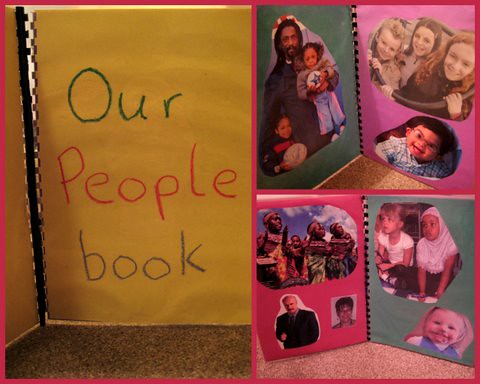
We’ve had our People Book for a couple of years now and it’s loved by the babies and toddlers who read it. Very young children are naturally drawn to looking at faces, so why not capture their interest by making a book of their favourite faces for them.

Our book includes lots of pictures of people the children know: themselves, family and friends. They just love it when they spot someone they recognise! It also provides lots of opportunity to chat and ask questions about what everyone looks like, and to play i-spy.

We’ve added in some pictures from magazines so we could include a whole range of people: different ages, sexes, hair and skin colours, wearing glasses, wearing headscarves, in wheelchairs, in different family groups. It’s a good way to introduce aspects of the world to your child – and if you’re working in an early years setting and wanting to provide multi-cultural resources, this is a great way to reflect your society. It can also be a useful way to link home and an childcare setting, as you can ask parents to send in some pictures from home for you to include.

You could also make a version that includes faces showing different emotions, and begin to talk about having different feelings.

We glued our faces onto coloured sugar paper, laminated them and then bound them together, which gave us a sturdy book which has lasted lots of toddler handing. If you don’t have access to a laminater, a photograph album or a scrapbook are good alternatives.

Do you make you own books with your children? Do they read them as much as other story books?

Related Posts Plugin for WordPress, Blogger...